
How to:
Plan a Novel
A good book feels rewarding. The questions raised in its very first chapter follow the main character all the way to the last page. But how do you get there? Some write from the gut, others plan. Both camps (pantsers and plotters) have their pros and cons, but today we're talking about proper planning: how to start a plan, follow it, and actually grow it while you draft.



What is a plan?
When starting a book, we tend to see fragments of a story, but rarely the whole picture. That's good; discovering your book while writing it is part of the craft. Still, there's a principle we run into more often than we'd like: we don't know what we don't know. How could you know what happens on page 157 before page 1 is even written?
So think of a plan as a living artifact, one that evolves with the book. If it's too narrow, it will cut off your creativity; if it's too loose, it gets abandoned after the first couple of chapters. The perfect plan doesn't exist, but a good one lives somewhere between the lines.
Imagine it this way: you're taking a trip to a new city. The hotel is booked, maybe one or two activities, but everything in between stays open. A few fixed points give you direction, and the space between them is yours to wander. That's what a good plan feels like.
Ideate first
Sounds simple, but it's sometimes the greatest challenge. Sure, we all have a million ideas, but as soon as we dig in, most of them turn out to be thin. In my experience, there's no formula for telling which idea is worth pursuing. For me, it comes down to the vibe an idea gives off, and whether I can see myself committing years to it.
Personally, I have two buckets of ideas: the good ones and the ones that stick. The first are solid material for a book, no question; they go into my idea vault. The second kind keeps pulling me back, over and over again.
If you have zero ideas about what to write but want to write no matter what, I recommend looking at your profession and hobbies. Pick a topic you know. Say you have an office job, and in your spare time, you like to do sports. Now ask what-if questions and let them get crazier and crazier, right up to the point where you stop liking it.
What if I were to resign from my job and open a squash hall? How would I resign? What would my colleagues do? What if I just left and never came back, without letting anyone know? What if I were to organize an underground squash league in the subway tunnels of New York? What if this becomes an urban myth? Would I meet new people? What if one of them is a greedy guy trying to capitalize on my idea? How would I react?
Wrong direction? No problem, we simply start again.
What if I were to resign from my job … but before I can, I get murdered in the office? How was it done? What if it happened in the middle of the day and no one noticed? What if one of my colleagues did it? How would they have done it? Who would have a motive? What if the building was locked the whole time? What if the weapon was hidden in my squash ball?
You see where this is going. And good news: you can do this all day. Got a five-minute break at work? Get your notebook out and start ideating. Maybe you get stuck at first, but with some time and the right topics, I'm confident everyone can piece a good story together.
Draft the outline of your story
Now we've got an idea, a rough sketch of what we want to write about. A story worth telling. The next question: what actually turns it into a book? You can keep the what-if exercise running until the plot feels complete, or you can come at it from a different angle.
What I like to do is put everything into a plan: take a piece of paper and map out a timeline. We know it all starts with our squash guy quitting his job. But where does it go from there? What's the end goal? Is there a deeper mystery? A complex motive for the murder? Who are the characters?
Depending on what you write, genre conventions come into play. A murder mystery makes it pretty clear what the reader expects; a non-fiction book about plants, on the other hand, leaves most of it up to you.
So let's turn our idea into a proper murder mystery. The genre usually comes down to one question: whodunit? Underneath sits a classic three-act structure (which doesn't mean you can't break out of it):
- Exposition
- What's on the line?
- Who are the characters involved?
- What happened?
- Rising Action
- Who could be the murderer?
- How has the case evolved?
- Is there a major turning point the main character has to overcome?
- Resolution
- Who really did it?
- How did we find the solution?
Based on this structure (or any other), you can start drafting first ideas and thinking about the timeline. You fill it in, and piece by piece, a story comes together. It's also the first moment you can see whether it works and where the gaps are.
In our case, it could look like this:
- Exposition
- Steve wants to leave his job after he discovers his boss is involved in shady business. The next day he enters the office, but he will never leave it again.
- Only five people are with him in the office:
- Samantha, his best friend, whom he knows from college.
- Brian, the facility manager.
- Clara, his boss.
- …
- After Steve turns on his computer, he suddenly feels sleepy; a minute later, he falls asleep and dies silently at his desk. On the screen: an open document. Written in big letters, it reads, "Clara has killed me."
- Rising Action
- Clara has the most obvious motive, but she didn't do it; she couldn't have, as she arrived shortly after Steve died. Brian, on the other hand, was directly behind him when it happened. But actually …
- After some time, the police arrive; a young officer called Ramira Ortez starts to interview everyone, but with every story, a new picture emerges.
- Ortez leaves the office; just as she returns, someone screams. Clara has been found dead too. On her computer, the same document, but this time with a second sentence: "Clara has killed me, or was it Steve?"
- Resolution
- Was it Brian, who got mocked by Steve and Clara, or was it someone else? Was the squash ball a tiny drone, armed with a poisoned needle? I'll leave the resolution to your imagination.
Now we have an outline that helps us connect the dots, and just as importantly, we can see what's missing. Who are the other characters? From which perspective do we want to tell the story? Maybe Ortez's view is the most interesting one, or do we shift the murder to someone other than Steve and use him as the perspective character?
Congratulations, you've crossed the biggest hurdle. You might have noticed that by now, the ideas arrive on their own. That's because you've opened a universe, starting from one simple what-if question and circling it until a whole plot emerged. From here you can start writing, map out chapters, or go even deeper into detail. But be aware: the more you plan, the stiffer your project gets.
While you write
You write and write and write, and at the end of a very productive session, you lean back to admire your work. You proudly scroll through your document, and there it is: your main character is not following the plan.
We all know and fear this moment. Hours of replanning ahead, and the questions start circling. What consequences will this have? Will my final reveal still land? What does this mean for the rest of the book?
That's the beauty of a plan. It only holds until it doesn't, and then you change it. The key is finding the middle ground: a plan detailed enough to give you a path, and loose enough to let you leave it for a while.
Level of depth
As with every topic, you can nerd out completely, building a plan that tracks every step of every character through the whole book. Or, as in our murder mystery, you follow three rough pillars. Between those extremes lie many levels of depth.
A good practice is to follow your characters, or to divide your book into storylines. You'll have a main one: Steve got murdered. But maybe around the corner there's a love story; perhaps Ortez and Steve met the day before and fell in love, and now she has to hide it and somehow get her DNA off him. Or Brian, the facility manager, had borrowed money from Steve. So we've got the whodunit, the love affair, and the borrowed money.
Each storyline needs its own level of detail to work out. Once your plan is laid out, you can look at how they fit together, where the pieces need to be placed, and when they have to be revealed.
You could decide, for example, that chapter one is Ortez meeting Steve in a bar. She doesn't catch his name; it's dark, and she's drunk. When she arrives at the scene, she doesn't recognize him. Only a few chapters later, a small detail from that night in the bar makes her realize who he was.
Let me show you what this looks like in practice, with the Die Pearltrilogy I'm currently writing. It began with a what-if question quite different from the story it tells today, but that question built the universe: What if the earth is dying, and the only way to keep it alive is importing enormous amounts of resources from other planets? How would we do that? Chasing the answer, I invented the planet Hemera, home to a human-like species oppressed by actual humans and forced to export their resources, their own world dying so that the earth can stay alive. And in this universe, a story unfolds: an unlikely friendship that gets dragged into the biggest turning point in Hemera's history.
From there, I had a strong sense of a conspiracy behind it all, and of the different angles I wanted to use to tell it. So I mapped out a timeline, set the start and the end, and filled in the steps between them. While writing, the plan changed constantly. Once the first rough draft was done, I came back, adjusted the timeline, and started planting little hints everywhere: some to make the plot click, many more to prepare the trilogy's payoffs.
That way, I could see quite quickly which storyline had gaps and which was overloaded. It also helped me balance the chapters: I merged a few and added new ones where depth was missing. The plan was what glued the book together, and it carried me all the way into editing. Even there, I could still check whether a small detail mattered, so if a sentence had to be rewritten, I wouldn't accidentally lose a well-planted hint.
Summary
Planning can be everything and nothing, but one thing it's not. Boring. It's a tool for every phase of your book.
In the idea phase, it tests whether an idea has depth. In the planning phase, it's essential for building a balanced outline. While writing, it keeps you on track and makes sure your chapters don't pile up unevenly across your acts.
After all, a well-planned story can make the difference between a good book and a great one. It can turn a flat plot into a deep one and reward your readers with hints placed at exactly the right time.
Planning in opaopa studio
Everything above is exactly why we built a planning mode into opaopa. The biggest weakness of any plan is drift: the manuscript moves on, the plan stays behind, and at some point you stop looking at it. So we designed the Plan Board to keep up with the story.
You start on an open board and lay out your storylines as strands. Every card can be linked to Story Bible entries and chapters, so while drafting, you always see what you actually planned for the chapter you're working on.
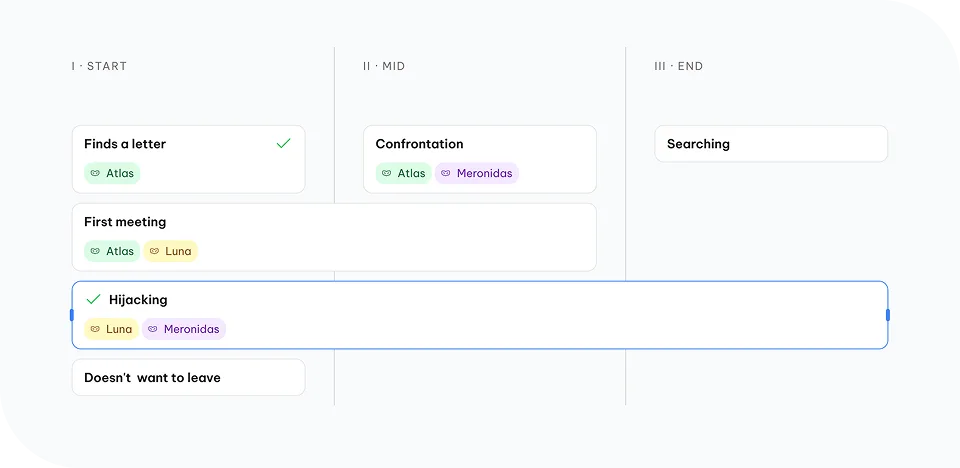
You can mark cards as done, filter the board, and switch to a tags view that sorts your cards by Story Bible entries. That's where the insights live: Is a character absent from a whole part of the book? Is there a storyline you never finished?